
《Healing is Voltage - The Handbook》與基礎科學研究之關聯The Scientific Foundations of “Healing is Voltage: The Handbook”: An Expert Analysis
前言 / Introduction
中:
Jerry L. Tennant醫師所著《Healing is Voltage - The Handbook》自問世以來,對能量醫學及整體健康管理領域產生廣泛影響。該書強調生命系統內潛藏的「電壓」及其對健康、疾病和自我修復的關鍵作用,提出一系列與細胞電壓、經絡、筋膜與慢性病機制等相關的假說,並嘗試連結現代細胞生物學、生物電學、筋膜解剖學與代謝醫學等領域的前沿研究。作為能量醫學專家,本文將深度剖析書中主要觀點與科學依據,並就其可驗證性及與現代醫學的橋接,提出專業見解。
En:
“Healing is Voltage – The Handbook” by Dr. Jerry L. Tennant has made a substantial impact on the field of energy medicine and holistic health. The book underscores the central concept that “life is controlled by voltage,” arguing that cellular electrical energy is essential for health, disease management, and tissue repair. In constructing his thesis, Tennant bridges cellular voltage, meridian theory, fascial networks, chronic disease mechanisms, and several related hypotheses, connecting them with modern disciplines such as cell biology, bioelectrics, fascial anatomy, and metabolic medicine. As an expert in energy medicine, this analysis will critically examine Tennant’s principal hypotheses, the current scientific context, and the scientific testability and translational potential of these concepts.
細胞電壓:健康、疾病與修復之核心 / Cellular Voltage: The Core of Health, Disease, and Repair
細胞膜電位與健康的生理意義
Cell Membrane Potential and its Physiological Importance
中:
Tennant博士在書中明確指出,人體每一個細胞均依賴特定的膜電位(resting membrane potential, RMP)以維持其正常功能。神經、肌肉、內分泌及免疫細胞均通過膜電位調控訊號傳導、新陳代謝與修復機制。根據主流生理學,細胞膜電位主要由內外離子濃度差異、離子通道和離子泵共同建構,多數細胞的RMP約為-40到-90 mV,其內負外正。
書中強調,細胞如「電池」般須持續維持充足電壓(約-25 mV為健康運作,-50 mV為新細胞生成所需)。當電壓低於-20 mV,細胞修復遲緩並漸趨疾病狀態。這一觀點可與現代細胞生物學中膜電位對細胞生長、分化、凋亡與代謝異常的研究相呼應。
En:
In Tennant’s exposition, each human cell depends upon a specific range of membrane voltage (resting membrane potential, RMP) to function optimally. Neurons, myocytes, endocrine, and immune cells all rely on this membrane potential for signaling, metabolism, and repair mechanisms. Mainstream physiology explains that membrane potential arises from ionic concentration gradients, selective ion channels, and ion pumps, resulting in an RMP typically between -40 and -90 mV (inside negative relative to outside).
Tennant likens cells to batteries, emphasizing the necessity of maintaining an adequate voltage (about -25 mV for healthy operation, -50 mV to drive new cell generation). Below -20 mV, cells cannot repair efficiently and shift toward disease. This foundational concept resonates with contemporary research on the role of membrane voltage in cell growth, differentiation, apoptosis, and metabolic dysfunctions.
電壓低落對健康的影響與慢性病模型
Impact of Low Voltage and Model of Chronic Disease
中:
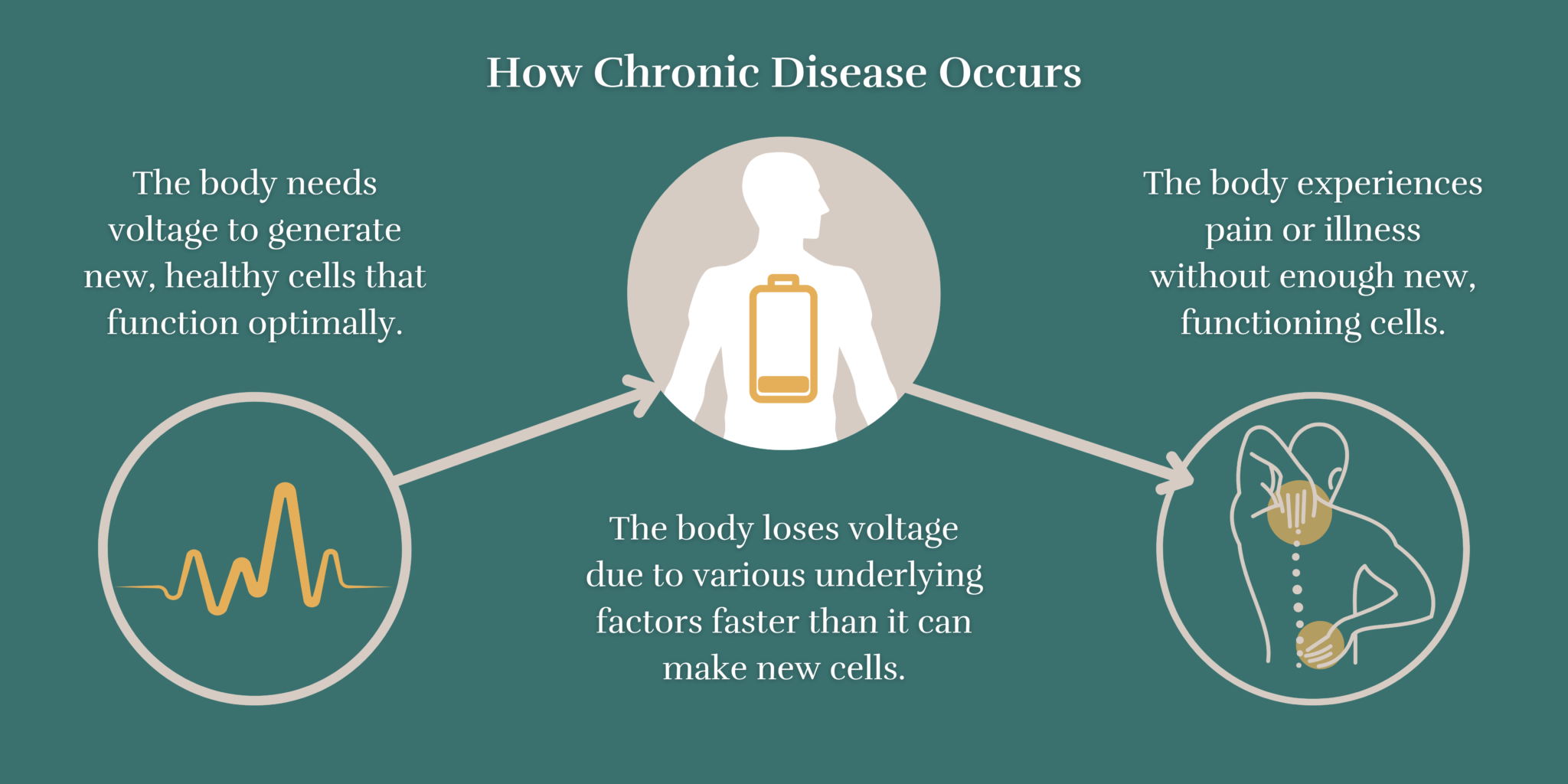
Tennant提出,所有慢性病皆「以細胞低電壓為根本」,低電壓令細胞失去分裂、修復與新生能力。這與現代理論一致,臨床實證顯示膜電位不足導致組織發炎、缺血、水腫、慢性疼痛,並與癌症、心血管病、糖尿病等高關聯性。近代醫學研究亦確認,膜電位下降會影響轉運功能、氧氣與營養輸送、廢物清除與細胞活力,開啟病理級聯反應,對慢性病與老化機制扮演核心角色。
En:
Tennant maintains that all chronic diseases ultimately “are defined by cells with low voltage”—dysfunctional cells are unable to divide, repair, or regenerate. This aligns with contemporary observations: clinical evidence links insufficient membrane potential to inflammation, ischemia, edema, chronic pain, and high incidence of cancer, cardiovascular disease, and diabetes. Contemporary medical research confirms that the decline in membrane potential impairs transport functions, the delivery of oxygen/nutrients, waste removal, and cellular vitality, triggering pathological cascades central to chronic diseases and aging.
細胞健康與修復需求的電壓標準
Voltage Standards for Health and Repair
中:
書中具體指出,細胞需維持-20至-25 mV以運作,需-50 mV來生成新細胞;慢性病患者電壓常低於-20 mV。這一數值與現代膜電位生理之數據基本一致。例如,健康神經元及心肌細胞分別約-70 mV和-90 mV,且膜電位的重設為細胞修復的必要條件。
此外,Tennant強調應檢測個別器官區域的電壓,並設計出相對應的生物電測量方法(如皮膚和經絡相關測試)。目前,實驗室常用微電極、膜片鉗技術與新型的光學及電極陣列,已可精準量測細胞及組織電位動態。
En:
The book specifies that cells need to maintain -20 to -25 mV for normal operation, and -50 mV for new cell synthesis; chronic disease states register below -20 mV. These values closely match modern physiological metrics: healthy neurons and cardiomyocytes average about -70 mV and -90 mV, respectively, and restoration of membrane voltage is essential for cellular repair.
Furthermore, Tennant advocates assessing regional voltage across different organs, proposing corresponding bioelectrical measurement techniques (e.g., skin/meridian testing). Modern laboratories utilize microelectrodes, patch-clamp methods, and advanced optical/electrode array techniques for dynamic, precise measurement of cellular and tissue membrane potentials.
電壓、pH與電子供應/竊取機制 / Voltage, pH, and Electron Donor/Thief Mechanisms
中:
Tennant將pH與電壓緊密關聯,主張「電壓即pH」,並將電子供應(donor)或竊取(thief)機制作為調控體內電壓的關鍵。理論上,pH值本質上與氫離子的電化學梯度和細胞膜電壓高度相關:
- pH = -log[H+ ],
- 越高的pH值(鹼性)表示電子可供,亦即能量充足,可支持還原反應和細胞修復;反之,低pH值(酸性)代表電子匱乏,細胞更易受損。
- 書中指出:「一切能釋放電子者為還原劑/電子供應者,一切能攫取電子者為氧化劑/電子竊取者。」喝酸性水、接觸電子竊取劑(如污染物、毒素)會降低體內電壓,促使慢性病發展。這觀點呼應細胞與組織的氧化還原(redox)平衡學說,現代醫學已證明氧化壓力、電子流失、慢性發炎密不可分。
En:
Tennant tightly connects voltage and pH, declaring “voltage is pH,” and emphasizes electron donor/thief mechanisms as essential for modulating internal voltage. Theoretically, pH reflects the electrochemical gradient of H+ ions and is deeply tied to cell membrane voltage:
- pH = -log[H+];
- Higher (alkaline) pH signifies abundant electrons and sufficient cellular energy for repair and reduction reactions; lower (acidic) pH indicates electron deficiency and greater susceptibility to damage.
- Tennant’s premise: “Anything that releases electrons is a reducer/electron donor; anything that steals electrons is an oxidizer/electron thief.” Acidic water or exposure to electron thieves (toxins, pollutants) depletes body voltage, fostering chronic disease. This view echoes the modern concept of cellular and tissue redox homeostasis; medical science confirms that oxidative stress, electron depletion, and chronic inflammation are tightly interwoven.
經絡、肌肉電池與筋膜導電網路假說 / The Meridian Reinterpretation: Muscle Batteries and the Conductive Fascia Network
書中對經絡本質的新詮釋
A Novel Reinterpretation of Meridians
中:
Tennant提出「經絡系統即肌肉堆疊的可充電電池」,其實質結構乃由相連肌肉組合成的「肌肉電池堆」(muscle battery packs),經絡路徑對應筋膜結構,筋膜則作為導電網路。此觀點強調肌肉收縮發電,以及筋膜的連續性和導電性,負責體內能量分布與器官修復。
En:
Tennant advances the hypothesis that “meridian systems are stacks of rechargeable muscle batteries,” positing that the structural substance of meridians is composed of interconnected muscle clusters (“muscle battery packs”) aligned with fascial pathways. The fascia, in turn, is seen as a conductive meshwork, mediating bioelectricity throughout the body and orchestrating energy flow and organ repair.
與筋膜解剖學與功能電生理之連結
Linking Fascial Anatomy and Bioelectricity
中:
近年筋膜學(Fasciology)研究證實,筋膜遍佈全身,由膠原蛋白、彈性蛋白與細胞外基質組成,含有豐富的感覺神經、血管、淋巴管,且具優異的生物機械傳導與一定程度的電傳導能力。實驗發現,筋膜可介導機械張力、空間定位、化學信號、甚至電訊號,並對細胞訊息、組織修復、張力平衡與代謝具有重要影響。Tennant假說之部分內容,如筋膜網路有助於能量訊號的傳遞、筋膜細胞參與感應與調節機制,已逐步獲得組織解剖與電生理研究的佐證。
En:
Recent developments in fasciology affirm that fascia is a near-ubiquitous tissue, composed of collagen, elastin, and extracellular matrix, harboring abundant sensory nerves, blood and lymphatic vessels, and demonstrating distinct biomechanical and some level of electrical conductance. Experimental studies show fascia mediates mechanical tension, spatial orientation, chemical and possibly bioelectric signaling, and is crucial for cellular communication, tissue repair, tension regulation, and metabolism. Tennant’s hypothesis—wherein fascia supports the transmission of energetic signals and fascia cells play roles in sensing and regulation—is increasingly corroborated by anatomical and electrophysiological research.
可驗證性與跨學科展望
Testability and Interdisciplinary Prospects
中:
此假設目前在現代科學中仍處於探索階段。以皮膚電阻點、良導點(acupoint conductance points)等電生理現象已獲證實,部分研究亦證明筋膜與神經、血管、淋巴、結締組織之結構和功能關係密切。但「經絡即肌肉電池+筋膜導電網」的模型尚需大樣本動物實驗、組織電生理檢測與高空間解析生物成像進一步驗證。
En:
While these hypotheses remain exploratory in modern science, phenomena such as skin resistance at acupuncture points and acupoint conductance have been confirmed, and multiple studies have verified close anatomical and functional links between fascia, nerves, vessels, lymphatics, and connective tissue. However, the “muscle battery + fascia conductive network” model requires further large-scale animal experiments, tissue electrophysiology, and high-resolution biological imaging for definitive validation.
慢性病與腫瘤的電壓病理模型 / Voltage-Based Disease Models: Chronic Illness and Cancer
慢性病的低電壓模型
Low-Voltage Model of Chronic Illness
中:
Tennant將慢性病歸因於「細胞無法維持足夠電壓所致之修復障礙」。這與慢性發炎起始於細胞膜電位受損、離子泵失衡、氧化壓力升高、代謝失調等現代理論高度一致。如高血壓、糖尿病、心衰竭、慢性疼痛等皆可追溯到細胞無法維持正常離子梯度、能量生產及廢物排除,最終導致組織功能衍變。近年研究已證實部分治療(如電刺激、磁療脈衝)可助細胞恢復電位、減輕發炎並改善臨床症狀。
En:
Tennant attributes the roots of chronic disease to “the inability of cells to maintain adequate voltage, hampering repair.” Contemporary models agree, showing chronic inflammation begins with loss of membrane potential, ion pump dysregulation, oxidative stress, and metabolic derangement. Hypertension, diabetes, heart failure, chronic pain—all can be traced to disrupted ionic gradients, impaired energy production, and waste removal, ultimately leading to organ dysfunction. Recent studies demonstrate that certain therapies (e.g., electrical stimulation, pulsed electromagnetic fields) help restore cell voltage, reduce inflammation, and improve clinical outcomes.
癌症與細胞膜電位的動態
Cancer and Membrane Voltage Dynamics
中:
書中特別強調低膜電位(去極化)與細胞惡性轉化、癌細胞增殖及遷移性的關聯。現代癌症研究顯示癌細胞膜電位明顯低於正常細胞,去極化促進腫瘤幹細胞活性、胚細胞性分化與轉移傾向,並且與腫瘤微環境內低pH及氧化壓力共同促發腫瘤進展。粒線體膜電位失調、電子流受阻更是惡性增生的重要生化指標。現今以生物電子介入(如質子幫浦、電場裝置)治療腫瘤已有早期臨床數據支持。
En:
The book highlights how low membrane potential (depolarization) is associated with malignant transformation, cancer cell proliferation, and metastasis. Modern research confirms that cancer cells display significantly lower membrane potential compared to healthy cells, and depolarization fuels tumor stem cell activity, embryonic-like differentiation, metastatic propensity, and, with acidic/oxidative microenvironments, drives tumor progression. Mitochondrial membrane potential dysregulation and impaired electron flow are critical biochemical signatures of malignancy. Bioelectronic interventions (e.g., proton pumps, electric field devices) for tumors now show early clinical support.
傷口癒合過程中的電壓調控
Voltage Regulation in Wound Healing
中:
Tennant強調傷口癒合原理須賴「細胞重獲足夠電壓」。從角質形成細胞的電動導引遷移,到血管新生與膠原蛋白合成,皆受電場與局部膜電位調節。現代研究已證明創傷邊緣局部正電場吸引細胞遷移、促進傷口縮合,而Piezo1等機械感測蛋白則能施以電壓訊號調節細胞運動。美國DARPA資助的“電動OK繃”通過生成局部電場顯著加速糖尿病慢性傷口愈合,強化了Tennant電壓修復模型的可行性。
En:
Tennant underscores that wound healing fundamentally relies on restoring cellular voltage. Every aspect—from electrotactic keratinocyte migration to angiogenesis and collagen synthesis—is regulated by local field potentials and membrane voltage. Modern science demonstrates that electric fields at wound edges attract cell movement and promote closure, while mechano-sensitive proteins such as Piezo1 mediate effects via voltage signaling. The U.S. DARPA’s “electric bandage” (WPED), generating a local electric field, dramatically accelerates wound healing—particularly in diabetic, chronic wounds—validating key parts of Tennant’s voltage-based wound repair model.
電壓與ATP生成及代謝效率 / Voltage, ATP Generation, and Metabolic Efficiency
電壓與粒線體功能及能量產生
Voltage, Mitochondrial Function, and Cellular Energy
中:
書中重申維持細胞電壓對ATP生成的決定性作用。粒線體氧化磷酸化(OXPHOS)本質上即需膜電位(ΔΨm)作為質子動力,推動ADP磷酸化生成ATP。研究證實,ΔΨm降低將導致ATP產量劇減、電子傳遞鏈阻斷,並啟動細胞凋亡程序。這也解釋了低電壓(不論細胞膜或粒線體膜)之細胞,容易進入死亡、無法修復、容易腫瘤化的機理。
En:
The book reiterates the critical role of voltage in ATP generation. Mitochondrial oxidative phosphorylation (OXPHOS) requires the inner membrane potential (ΔΨm) to drive protons and phosphorylate ADP to ATP. Research shows that loss of ΔΨm leads to sharp declines in ATP output, disruption of the electron transport chain, and triggers apoptosis. Thus, low voltage—whether at the cell membrane or mitochondria—predisposes cells to death, failed repair, and transformation into malignancy.
電壓、代謝體學與慢性病
Voltage, Metabolomics, and Chronic Disease
中:
Tennant主張調控細胞電壓是一切能量代謝效率的樞紐。現代代謝體學、代謝流(metabolic fluxomics)表明,粒線體膜電位下降與代謝紊亂、糖尿病、癌症、高血脂症、失眠等多種慢性病高度相關。具體表現如葡萄糖與游離脂肪酸代謝受阻、氧化還原不平衡、胰島素抗性等。新興治療如電位治療、電生理同步刺激等,能部分改善細胞電位與能量代謝,已進入早期臨床應用。
En:
Tennant contends that cell voltage regulation is central to all metabolic efficiency. Modern metabolomics and metabolic fluxomics show that declines in mitochondrial membrane potential are strongly associated with metabolic dysfunctions—diabetes, cancer, dyslipidemia, insomnia, and more. Manifestations include impaired glucose/fatty acid metabolism, redox imbalance, and insulin resistance. Novel therapies—including voltage therapy and electric synchronization—have shown early promise in improving cell voltage and energy turnover.
生物電學與現代細胞電壓科學之交集 / Bioelectrics and the Convergence with Modern Cellular Voltage Science
細胞膜電位的機制與測量
Mechanisms and Measurement of Membrane Potential
中:
現代細胞生物學已詳細解析細胞膜電位建立的生化物理機制。離子通道(如Na+、K+、Cl-通道)與離子幫浦(Na+/K+泵)共同維持膜電位,動作電位的產生乃細胞間高效訊號傳導的核心。膜片鉗技術、微電極記錄與新型光學/電子電極陣列,讓科學家能精確量測單細胞或組織的靜息/動作電位與電流,廣泛應用於藥物、再生醫學與神經學的跨領域研究。
En:
Modern cell biology has elucidated, in detail, the biochemical and physical mechanisms by which membrane potentials are established. Ion channels (for Na+, K+, Cl-) and ion pumps (Na+/K+ pump) work together to maintain membrane potential, with action potentials underpinning rapid intercellular signaling. Patch clamp, microelectrode recordings, and new optical/electrode arrays enable precise measurement of resting/action potentials and ionic currents at single-cell or tissue scale, with broad application in drug discovery, regenerative medicine, and neuroscience.
電壓假說的驗證策略
Validation Strategies for the Voltage Hypotheses
中:
科學驗證Tennant電壓模型可採多種跨領域設計,包括:
- in vitro單細胞、多細胞模式下的膜電位與細胞功能監測(活細胞染色、膜片鉗、TEER系統);
- 慢性病動物模型(心力衰竭、炎症、腫瘤)下細胞電位與修復效率的動態時間穩態追蹤;
- 結合代謝流分析,以穩定同位素追蹤物質流向,探測細胞能量轉換與病理演化;
- 生物電子學/機器學習控制的質子泵、可穿戴電生理裝置進行人體/動物試驗,從分子到生理層級驗證修復或退化趨勢。
En:
Scientific validation of Tennant’s voltage models can employ a range of interdisciplinary designs:
- Monitoring of membrane potential and cellular function in vitro (live-cell dyes, patch clamp, TEER systems);
- Dynamic, time-series tracking of cell voltage and repair efficiency in chronic disease animal models (heart failure, inflammation, cancer);
- Application of metabolic flux analysis (stable isotope tracing) to monitor molecular flow and pathological evolution;
- Bioelectronic/machine learning-controlled proton pumps and wearable electrophysiological devices for human/animal trials, enabling multi-tier validation from molecular to physiological levels.
能量醫學設備與臨床評估
Energy Medicine Devices and Clinical Evaluation
中:
Tennant BioModulator等生物調節儀在美國已通過FDA二級認證,被應用於急慢性疼痛管理與組織修復。大型隨機醫學試驗顯示,該設備與傳統針灸、TENS相比,具有相當的止痛與功能改善效果,且副作用低、便於自我管理,是非藥物療法的重要臨床補充。生物電調節針對慢性病患之修復、抗發炎與提升能量已獲初步證據,後續仍需結合大數據與深度隨訪以評估長期療效。
En:
The Tennant BioModulator and similar biomodulation devices are FDA-cleared for acute and chronic pain management and tissue repair. Large randomized medical trials demonstrate that the device is as effective as traditional acupuncture and TENS in pain control and functional improvement, with fewer side effects and high usability for self-management; it is an important adjunct to non-pharmaceutical interventions. Preliminary evidence suggests that bioelectrical modulation improves repair, reduces inflammation, and enhances energy in chronic disease cases, warranting further research employing big data and longitudinal follow-up to evaluate long-term outcomes.
總結:Tennant模型與現代科學的橋接 / Conclusion: Bridging Tennant’s Models to Modern Science
中:
總體而言,Jerry L. Tennant於《Healing is Voltage - The Handbook》所提出「細胞電壓乃健康、疾病與修復之主導關鍵」一說,與現代細胞膜電位生理、粒線體能量學、代謝流變分析、筋膜網路與組織電生理學高度契合。雖書中對經絡為肌肉電池、筋膜導電網路的獨特詮釋尚需現代生物物理學更深入實驗驗證,但其強調細胞電壓的重要性、電子供應與紅氧化平衡的關聯、以及將電壓納入慢性病與癌症診斷評估新指標的前瞻性,已獲多數主流學科承認。
En:
Overall, Jerry L. Tennant’s central thesis in “Healing is Voltage – The Handbook”—that cell voltage governs health, disease, and repair—resonates strongly with modern understanding in membrane physiology, mitochondrial energetics, metabolic flux analysis, fascia network science, and tissue electrophysiology. While the muscle battery/fascia network reinterpretation of meridians awaits rigorous biophysical substantiation, the emphasis on cell voltage, electron supply, redox homeostasis, and the integration of voltage as a diagnostic/prognostic biomarker for chronic disease and cancer is largely endorsed across disciplines.